


Can a half-degree ruin a pharmaceutical shipment in Dubai?
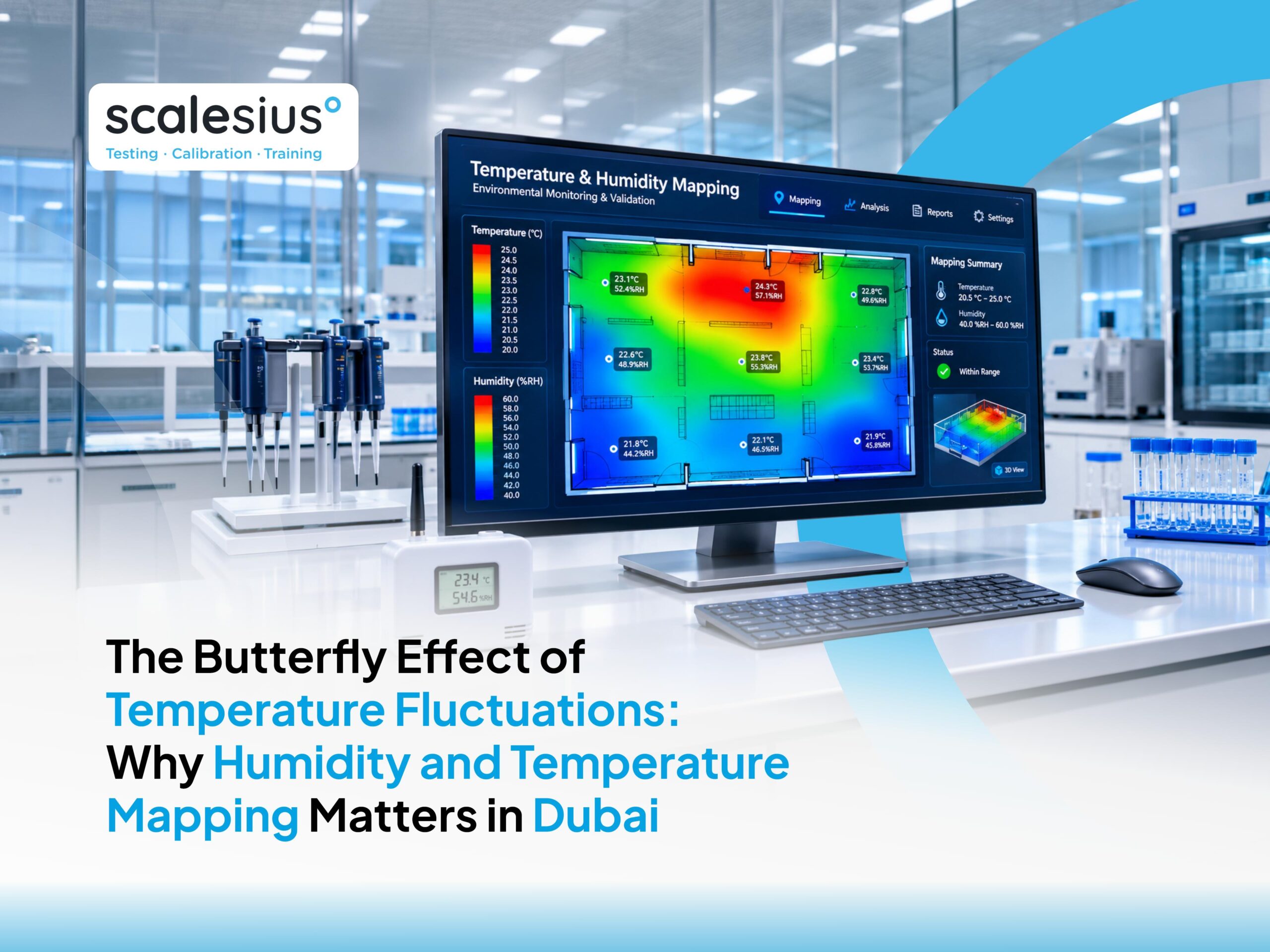
Yes, it can. When temperature and humidity amplify it. Scalesius's Temperature and humidity mapping reveals hotspots, cold spots, and damp zones that single sensors miss. We help facilities place sensors accurately and keep their storage stable.
Think of a domino rack. You tip the first tile, and the last one still falls. The butterfly effect works the same way. One small change sets off a chain reaction and each step grows the damage. For example, in a pharmaceutical store, the first tile to fall is often half a degree out of place. Temperature mapping in Dubai finds this fluctuation before the whole outcome is affected.
As a Dubai calibration services provider, Scalesius runs professional temperature and humidity mapping services inside pharmaceutical facilities, warehouses and food storage premises. Our calibrated loggers record conditions within certain time periods. We provide reports to show exactly where small fluctuations begin and how far they travel. You then know exactly what to rectify.
Understanding the Chain Reaction of Temperature and Humidity Fluctuations
Let's start with physics. Warm air holds more water vapour than cool air. Relative humidity shows how full that air is of water vapour at the current temperature. This is why the two variables move together. Cool the air and relative humidity rises. If you warm it, then relative humidity drops.
Likewise, a pharmaceutical warehouse has a small climate of its own. Evaporators chill the air, racking blocks airflow and Dubai's heat floods the roof. Additionally, there may be staff causing other disruptions.
Each of these disturbances sets off the next one.
- A warm spot dries the air around it.
- A cold spot pushes humidity up, and condensation follows.
- The moisture present can corrode electronics or soften cartons.
Temperature fluctuations like this rarely stay at a point. They most likely drift from shelf to shelf, hour by hour. Temperature mapping is what exposes that shift. Scalesius places calibrated loggers at points like corners and the room centers, doors and loading bays, evaporators, air vents, and shelves. These loggers record humidity and temperature side by side.
Humidity also has its own sources.
In a pharmaceutical facility, moisture usually enters through
-
Door openings that let in humidified air
-
Defrost cycles that release water from coils
-
Wet floors after cleaning
-
Staff and trolleys moving between zones.
A premise may have hundreds of instances where temperature and humidity could fluctuate. Scalesius maps both variables across all premises.
Need accurate temperature and humidity mapping for your facility?
Get in touch with Scalesius at +971 4272 1561 or hello@scalesius.com.
The Humidity Paradox: Why Controlling Temperature Alone Isn't Enough
Here's the paradox. A room might have the perfect 4°C and still ruin its contents.
The climate in Dubai makes this harder. Humidity in Dubai on July 2026 transitioned from 10% to 80%, with a monthly average of 45%. The peak came at 4:00 AM on 9th July, and the lowest arrived at 5:00 PM on 2nd July. Different factors affect these transitions and the temperature and humidity swings.
In pharmaceutical storage, there are certain temperature ranges that must be followed. Room temperature medicine must stay between 15°C and 25°C. Vaccines must be kept in a separate refrigerator with a temperature range of 2 to 8°C. When it comes to humidity in storage areas, it must be no more than 60%.
A single sensor placed can also mislead. It might read 5°C, while a pocket behind the door read 9°C, outside the vacuum range. The sensor isn't faulty. It's just that sensors haven't been placed at the right places for the right readings.
This gap is what Scalesius aims to close. We map temperature and humidity inside pharmaceutical facilities, warehouses, cold storage premises and more across Dubai. Each study we perform follows five steps.
-
We do a review of the whole site where layout, airflow and storage zones are studied.
-
We calibrate and place loggers in a planned grid.
-
We do a thermal mapping for live condition logging that follows normal operations. This includes every door open events and delivery windows.
-
Our team takes into account your required ranges and analyses every hotspot, cold spot, and damp pocket in your premises.
-
We create a report that shows where a permanent temperature and humidity monitor should go and help place it accordingly.
Temperature mapping should also reflect the seasons. A July study and a January study tell you two different stories. Scalesius advises us to repeat the study across seasons, as these findings can sharpen your environmental monitoring.
Who gains most from Scalesius's temperature and humidity mapping study -
-
Pharmaceutical facilities
-
Warehouses and distribution centres
-
Food storage premises
-
Healthcare and Laboratories
-
Cold Chain Logistics
Preventing the Ripple Effect: Making Environmental Stability a Priority with Scalesius
Every chain has a first drift. Nobody can stop every small shift. But a half-degree drift doesn't have to become a rejected shipment.
Mapping gives you that knowledge. A temperature monitoring system then protects it day after day. Without the map, devices sit in guessed locations. With it, every sensor earns its spot.
The stakes keep rising. Mordor Intelligence values the UAE cold chain logistics market at USD 1.72 billion in 2026. Cold chain monitoring built on guessed sensor positions puts part of that value at risk.
A Scalesius study leaves you with:
- Exact locations of hot spots, cold spots, and damp zones
- A clear picture of how conditions behave through a normal operating cycle
- Sensor placement you can defend
- Calibrated data that holds up under scrutiny
Scalesius maps temperature and humidity across Dubai, from compact cold rooms to full warehouses. Planning humidity and temperature mapping in Dubai for your facility? Talk to the Scalesius team about scope, timing, and what your storage needs.
Need accurate temperature and humidity mapping for your facility?
Get in touch with Scalesius at +971 4272 1561 or hello@scalesius.com.